
Why it exists
Built around the idea that grip geometry influences how fingers share force, this design seeks to reduce positional bias and make loading more consistent across the hand.

Custom climbing tools shaped for deliberate finger training.
Aretera Climbing Precision Edge
A personalized finger trainer shaped to match your hand, not a generic flat edge.
Why it exists
Built around the idea that grip geometry influences how fingers share force, this design seeks to reduce positional bias and make loading more consistent across the hand.
What it changes
It shifts focus from total load alone to how load is distributed across fingers through posture and contact geometry.
How to use it in your training
Use it in max hangs or repeaters, either replacing or complementing standard edges with a more deliberate loading pattern. It can also be used as a warm-up tool to prepare the fingers with more balanced activation before harder efforts.
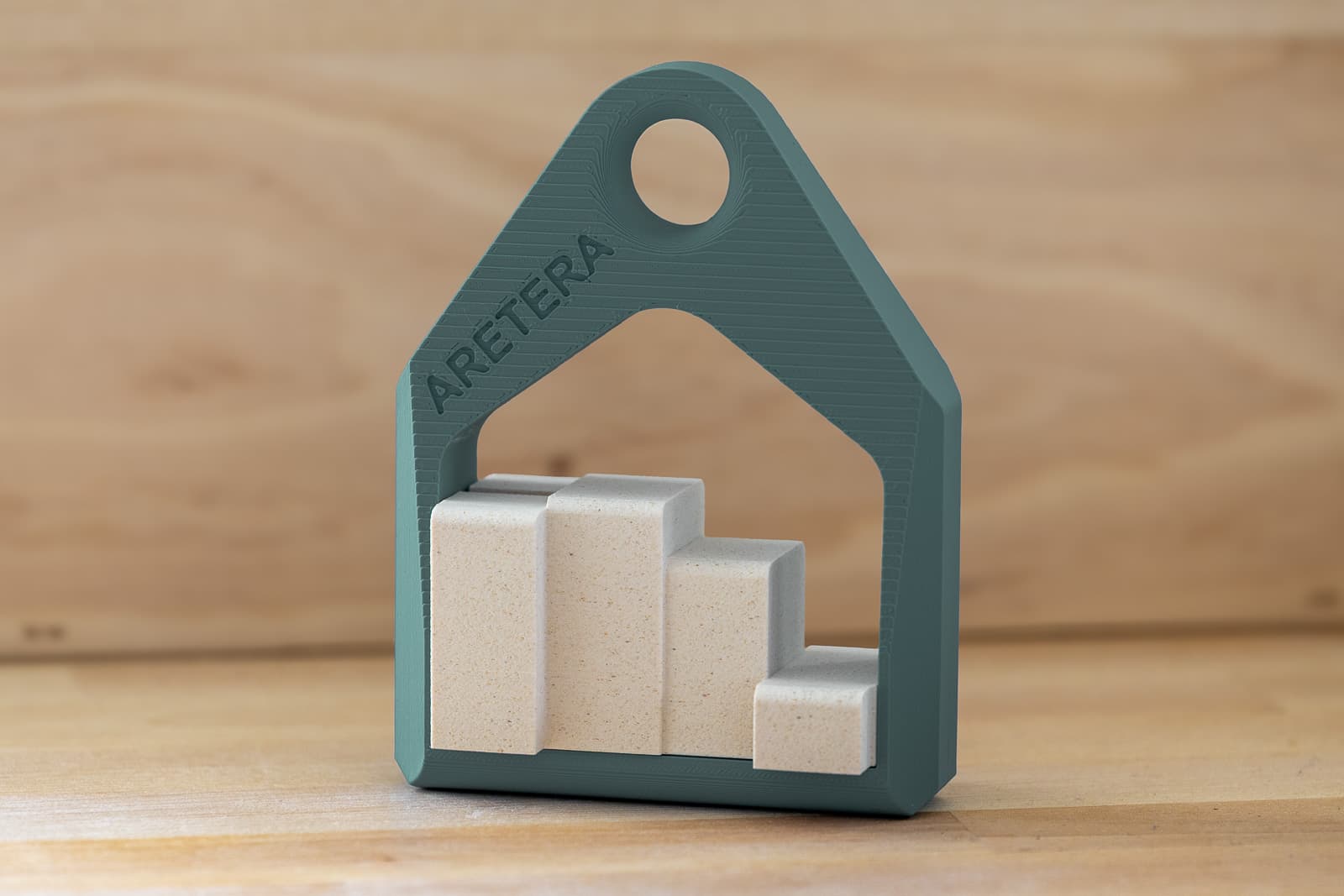
Made to measure
The shape is generated from your measurements in three dimensions, so the edge matches your hand instead of forcing you onto a generic profile.
01 / 05
Get yours now!
Made to measure
Measure your hand once, choose your format, and we'll handle the rest. Order a finished print or get an STL generated on demand immediately after payment.
Printed version
€49.00
Physical product, made to order and shipped from Sweden.
Ideal if you want your Precision Edge delivered ready to use.
STL download
€9.00
Generated on demand from your measurements immediately after payment and delivered by email.
Ideal if you have access to a 3D printer.
Printed orders ship within the EU for a fixed €9. Shipping outside the EU is currently not available.
Research-informed
These claims are written to reflect what the literature supports, what the product is designed to influence, and where the evidence is still incomplete.
Traditional flat edges force different fingers into different joint angles, creating a mechanical bottleneck where the least favorable finger can limit total output. By normalizing finger posture, more of each finger's potential force may be expressed simultaneously. Multi-finger research shows that maximal force is not simply the sum of individual fingers because coordination limits create a measurable force deficit, which means task geometry can plausibly influence total output.
Sources
Li et al., 1998; Zatsiorsky et al., 2000
What is not yet known
It has not been demonstrated that geometric normalization consistently reduces force deficit or improves coordination across individuals. The observed increase in total force could also arise from changes in comfort, contact mechanics, or neural strategy rather than improved biomechanical efficiency.
In standard hangboard training, 80% of max reflects total force while individual fingers often work at different relative intensities because load sharing is stable but uneven. Studies suggest middle and ring fingers frequently carry a disproportionate share. By aligning joint angles, this tool aims to reduce structural bias and move training closer to equal relative loading across fingers.
Sources
Vigouroux et al., 2008; Li et al., 1998
What is not yet known
There is no direct evidence that equalizing joint angles leads to equalized relative intensity per finger. Neural coupling, or enslaving, may still dominate force distribution regardless of geometry.
Finger injury risk depends strongly on joint angles and tendon mechanics, not just external load. Crimp-like positions can substantially increase pulley forces, and internal tendon-to-tip force ratios vary with posture. Research indicates that middle and ring fingers often approach critical pulley loads first, even when external forces appear similar. By standardizing geometry, this design may offer a way to influence internal load distribution and reduce extreme local stress.
Sources
Vigouroux et al., 2008; Dennerlein et al., 1999; Schweizer, 2001
What is not yet known
Equalizing external force or joint angles does not guarantee equal internal tendon or pulley loading. Anatomical differences and tendon routing may still produce asymmetric internal stress.
Disclaimer
This product is based on established principles from biomechanics and motor control research, but its specific effects have not yet been validated in controlled clinical or longitudinal training studies. The claims above describe plausible mechanisms and observed tendencies, not guaranteed outcomes. Individual responses may vary depending on anatomy, training history, and technique. This tool is not intended to diagnose, treat, or prevent injury, and should be used with the same caution as any high-intensity finger training.
